
Like many Canadians, we’ve been watching and enjoying (and stressing through, maybe a little…) the Stanley Cup Playoffs.
Beyond being truly an amazing part of our Canadiana, hockey is an interesting sport in terms of its luck factor, and for us, that’s a tie to consider from an investing context.
Hockey, Luck, and the Investing Parallel
Michael J. Mauboussin is a well-known investment strategist, author, and academic who focuses on how to make better decisions under uncertainty, especially in investing. The table below comes from some of Mauboussin’s work, which was republished in another book about luck and life, The Random Factor by Mark Robert Rank.
The Contribution of Luck in Five Professional Sports Leagues
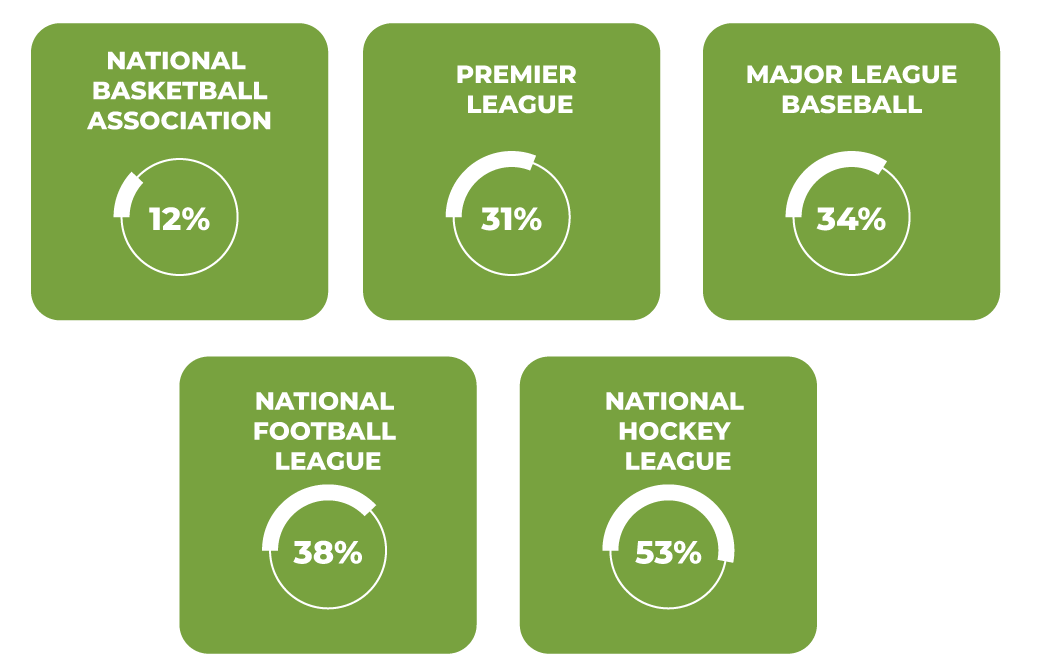
There is a concept that luck varies by domain. Mauboussin places activities on a continuum from pure luck to pure skill. The above is just looking at that spectrum within sports leagues.
In an NHL game, of all the professional sports leagues in North America, you are watching luck determine the outcome. The skills and the talents of both teams are more or less evenly matched; luck, the bounces, the breaks, whatever you call them, are making an NHL game a “coin flip” outcome.
Sports can reward skill more reliably, such as in basketball or soccer. However, hockey is a domain that obscures skill with luck.
And investing is a similar domain to hockey. In investing, you can do everything right and still lose money. You can still make the wrong investment pick, still overestimate your skill and experience the “bad bounce” off the boards.
The Case for Owning the League
If investing imitates sports (and sports imitate life), index investing is in many ways a natural response to this reality. Rather than trying to separate skill from luck, it accepts market returns, minimizes costs, and broadly diversifies.
In that sense, indexing (and its sibling, enhanced indexing) is not just a low-cost option; it is a disciplined strategy grounded in the recognition that uncertainty and randomness play a much larger role in investing than we intuitively believe.
Investing looks much more like hockey than chess. A great team can outshoot, outplay, and still lose because of a hot goaltender, a bad bounce, or a deflection. Over a season, skill emerges, but in any given stretch, randomness plays a significant role.
The Takeaway
Just as you wouldn’t judge a hockey team on a single game, or assume the winner is always the better team, it’s equally important not to over-interpret short-term investment outcomes. (There we go talking about long-term investment horizons again…we’ll leave that for another PWM Perspectives!).
Going back to the table above, one can still recognize that skill exists; however, the influence of luck makes consistently identifying and capturing it far more difficult than it appears. So, with that in mind, index investing becomes a way of “owning the league.” Though you might not want to cheer for all the teams in sports, in investing, we don’t mind.