PWM Perspectives provides valuable insights into market dynamics, investment opportunities through Q Wealth, and key financial indicators. We are committed to keeping you informed with timely updates from PWM Private Wealth Counsel and our partner, Q Wealth Partners, a registered Portfolio Manager providing Portfolio Management Services.
If you ask three people what a quarter section is worth, you will probably get three answers. Most likely the real estate professional will quote you a comparable sale number. From Farm Credit Canada (FCC), you will get the regional average. And the family who has farmed it since the 1950s will give you a number that has almost nothing to do with either. It's the professional opinion, research- and data-based price point, and the personal value number.
It's hard to wrap your mind around, but all three figures can be correct at the same time. That's because they are answering different questions. And the confusion between them, in our financial planning experience, is at the root of more difficult farm-family conversations than the combined topics of taxes, commodity markets, and interest rates.
Three numbers for the same quarter section
All three can be right at the same time. They answer different questions.
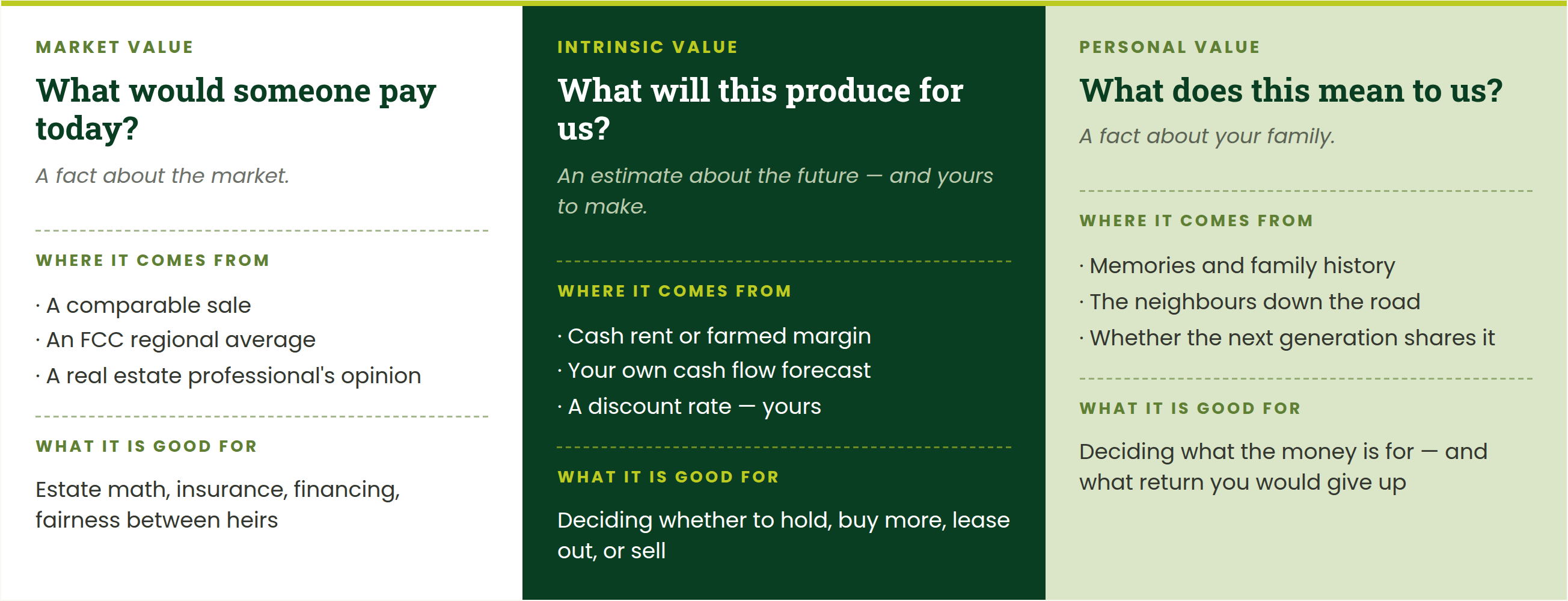
Framework prepared by PWM Private Wealth Counsel for discussion purposes. “Intrinsic value” follows Warren Buffett’s definition in Berkshire Hathaway’s Owner’s Manual — the discounted value of the cash an asset can produce over its remaining life — and is an estimate that depends on your own assumptions about rents, margins and discount rates. Book value, what you paid, is a fourth number: it describes your history and tax position, not what the land is worth now. Personal value is real but cannot be sold or divided. Provided for information only; not investment, tax or legal advice, and not a recommendation to buy, hold or sell farmland.
When you look at a typical farm family balance sheet, some line items will stand out as ones you can verify with a phone call or online search. A GIC or bank deposit, for example. Other cash and equivalent assets, with both book and market values, are also readily confirmable. These are what some may call pure exchange assets, and their values can be easily looked up.
Now look at everything else on the farm balance sheet. The house is shelter, safety, memories with your kids, and the community (the neighbours down the road, maybe the garden-fresh vegetables shared over the last couple of months). As our strategic partner, Tim Hammond likes to remind folks as well, the land is a business input, too. The shop and the green iron (or yellow or red) are productive capital and forty years of accumulated capability.
Almost every hard asset a farm family owns carries value that no market will pay you for. And those assets typically make up the overwhelming majority of the balance sheet. The assets that dominate a farm family's net worth are precisely the ones whose value cannot be read off a screen.
We suspect many would say, "Well, you need to look at value" or "it's not price, it's value." Readers might agree value is not just dollars and cents. However, the word "value" gets used loosely, so it helps to borrow from someone who has been careful with it for sixty years.
In Berkshire Hathaway's Owner's Manual, Warren Buffett defines intrinsic value as "the discounted value of the cash that can be taken out of a business" over its remaining life. That might sound like jargon, especially with the wording of discounted value (unless you've spent some time doing discounted cash flow analysis recently?). So here is a way to think about it; it's not what someone paid or even might pay. Intrinsic value is what the asset can be expected to produce for its owner, from here forward, expressed in today's dollars. Diving in, we think two parts are important for farmland owners.
First, it is deliberately forward-looking. Buffett draws a hard line between book value and intrinsic value. Book value records what went in, while intrinsic value estimates what will come out.
Now, on that part, substitute the farm as the asset versus a corporate entity or stock investment made by Mr. Buffett. What you paid for a quarter in 1978, or 1998, or 2019, is your book value. It tells you about your history and your tax position. Yet, it tells you nothing about what the land is worth now.
Second, Buffett openly concedes that the number is subjective. Intrinsic value is an estimate, not a measurement. It has to be revised when interest rates move or when cash flow forecasts change. In his 1994 letter to shareholders, he went further, calling anyone's intrinsic value calculation a "highly subjective figure." Two careful, well-intentioned people looking at identical facts will land in different places. Buffett has said this is precisely why Berkshire never publishes its own estimates.
So, the honest position is not "the market price is emotional and intrinsic value is objective." Really, both involve judgment. The difference is that intrinsic value forces you to be explicit about what you are assuming and why, while a market quote lets you skip that step entirely.
By the way, Buffett is not a theoretical example here. He actually owns farmland. In 1986, after the Midwest land bubble burst, he bought a 400-acre farm north of Omaha for roughly $700 an acre. He has been clear about his qualifications: "I still know nothing about farming." What he did instead was work out, with his son Howard's projections, that the farm should throw off a reasonable return on what he paid. It did, but that's not really the story.
In nearly three decades of ownership, he had visited the farm twice, never looked at the farmland price points, and from what we know, never considered selling. His stated lesson: "You don't need to be an expert in order to achieve satisfactory investment returns." But you do need to know what you own and what it produces.
However, there was something else at play for Buffett. It's a personal one that has nothing to do with dollars and cents. He bought that particular farm partly because his son Howard loved farming, and Howard has rented and operated it ever since. Even the famously unsentimental investor owns one asset with a family story attached. Financial decisions can, and in many cases are, emotional decisions.
And that's no different for many of our clients and prospective clients. They might keep the farmland to pass it down to future family members who will farm it. Maybe they want to rent it for passive income in retirement. Or maybe they are now trying to value the land for a sale, think about converting it to other assets that could generate income and help with financial plans and goals; maybe those RESPs for the grandkids, memories in Europe, that RV trip across Canada. Productive asset turned to other value.
Three patterns come up again and again in our planning work (we talked about financial plan inputs being so critical in our September PWM Perspectives). Inputs to the plan that misrepresent the actual asset position. We have seen that when personal value inflates the market estimate, families dismiss it when no one meets it, meaning the land isn't overpriced but isn't for sale at that price. Or in the rising farmland race, market value crowds out personal value; a record per-acre price tempts someone to sell land they'd prefer to keep, without considering what the proceeds are for. Or intrinsic value is never truly calculated. We know families can state the market rate per acre but haven't determined the percentage return on that value. Both figures are needed, but only one is easy to find.
Personal value is real. We would never argue otherwise, and the families we work with are not confused about whether their land matters. But personal value has two properties that are important to consider, and that are very hard to manage. Personal value cannot be "sold." A buyer will pay for the dirt, never for what it means to you. And it cannot be divided in any fashion. For example, three children cannot each inherit the same memory, though they can each inherit a third of the money.
That is not a reason to discount it, but it is a reason to fund it deliberately. The productive version of the conversation could sound like the questions in the graphic below (and by the way, in financial planning, this can be used for assets beyond farmland, whether it's your family home, the cabin, and so on):
Three questions before you decide
The productive version of the conversation — and it works for any asset you hold for more than one reason.
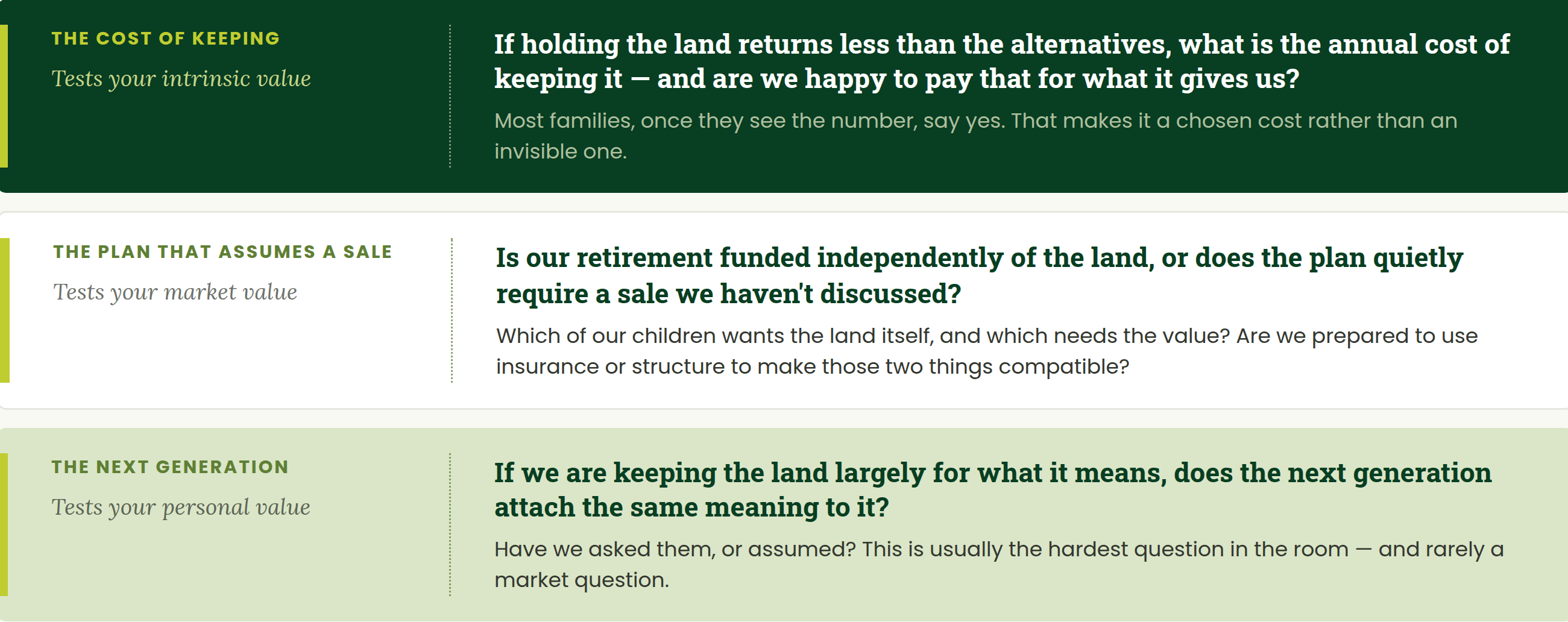
Discussion questions prepared by PWM Private Wealth Counsel to accompany “Three numbers for the same quarter section.” Personal value is real, but it cannot be sold and it cannot be divided — three children cannot each inherit the same memory, though they can each inherit a third of the money. Provided for information only; not investment, tax or legal advice, and not a recommendation to buy, hold or sell farmland.
That last question is often the hardest one in the room, and it is rarely a market question at all. Your farmland's price is a fact about the market. Your land's intrinsic value is an estimate about the future, and you should be the one making it. Your land's personal value is about your family, and no spreadsheet gets a vote on it (and no spreadsheet can truly optimize for it, either).
You need to address all three questions to make a good decision. Most families arrive with one. At PWM and Q Wealth, we would like to help you work out the other two.
Upcoming Events:

Life After Harvest Seminar: Farmland Prices & Your Wealth Plan
If you’re considering a sale, leasing, or transitioning your farmland to the next generation, this conversation is designed to bring perspective and practical insight. We'll explore some of the biggest decisions Saskatchewan farm families face and how thoughtful financial, tax, estate, and investment planning can help preserve what they've built and support future generations.
Whether you’re actively farming, retaining land as an asset, or planning for what comes next, this session is intended to help you move forward with greater clarity and confidence.
📆 Date: Saturday, October 31
🕒 Time: 9:00 am – 11:30 am
📍 Location: Saskatoon, SK (Prairieland Park)
Join us for this FREE Seminar and hear from a team of professionals dedicated to the farming industry. Topics we’ll explore:
- How do today's farmland values, market trends, and emerging risks affect your family's financial future?
- Should we sell the land or keep it?
- Are we ready to sell, lease, or transition the farm?
- How do we treat the kids fairly?
- Are there tax mistakes we could avoid before making a major decision?
- Does your family have a plan to protect your legacy and create financial confidence beyond farming?
- Will we be okay if we retire?