PWM Perspectives provides valuable insights into market dynamics, investment opportunities through Q Wealth, and key financial indicators. We are committed to keeping you informed with timely updates from PWM Private Wealth Counsel and Q Wealth Partners, our partner portfolio management firm.
January gave investors a clear, real‑time reminder that short‑term volatility is a normal part of investing. We are going to give a short recap of the last part of January, not to recycle the headlines and news, but as an example of this month’s “Perspective.”
The month began with a sharp downturn after President Trump threatened tariffs on eight NATO‑aligned European countries in a bid to gain leverage in negotiations over the purchase of Greenland.
Markets reacted swiftly. The S&P 500 fell 2.1%, which was the steepest drop for the benchmark index since October. The Dow Jones Industrial Average fell 1.8%. The Nasdaq composite fell 2.4%. These declines were driven not by fundamentals but by sudden geopolitical uncertainty. Volatility surged as the VIX reached its highest level in nearly two months, and safe‑haven assets soared. Gold rose above $4,750 per ounce, and silver hit record highs, further signalling investor unease.
Just days later, markets whipsawed in the opposite direction when President Trump formally withdrew the tariff threats during the World Economic Forum in Davos. The reversal immediately eased investor fears and sparked a sharp relief rally. CNBC’s headline was “S&P 500 has its best day in two months after Trump backs off Greenland tariffs.” The Dow gained 589 points, or 1.21%. The S&P 500 closed higher by 1.16% and had its best day since late November. The tech-heavy Nasdaq rose 1.18% and had its best day in just over one month.
This sequence of a sharp drop followed by an equally sharp rebound is not unusual. It reflected how markets typically behave when fear and uncertainty enter the picture: prices reprice quickly. Simply put, markets move.
History shows that volatility like this is entirely normal. Nearly a century of market data reveals consistent patterns: a 5% pullback occurs in 94% of years, a 10% correction happens in roughly two‑thirds of years, and even 20% drawdowns appear about one out of every four years.
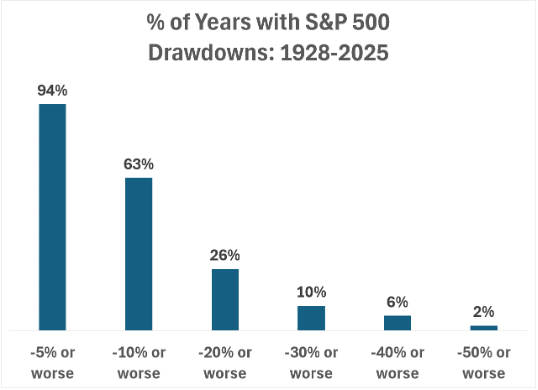
Investors often forget these statistics because long‑term performance charts smooth out the day-to-day investing experience. But volatility is not a sign that something is wrong. It is simply part of the market’s natural rhythm. More importantly, long‑term returns remain remarkably stable even though annual returns fluctuate dramatically. Volatility is temporary. Compounding is persistent.
Despite January’s swings, markets remain near record highs, which makes some investors uneasy. However, new highs alone are not predictive. Long‑term stock returns have averaged around 10% annually from 1928 through 2025, and markets often continue rising after reaching new highs. Believing a pullback is “due” is a behavioural bias known as the gambler’s fallacy. History strongly argues against basing investment decisions on that instinct.
If you're concerned about a market pullback after reaching new highs, it can be reassuring to see how uncommon it is for markets to decline afterward. The chart below shows how often the S&P 500 Index was higher or lower following a market high across different time frames.
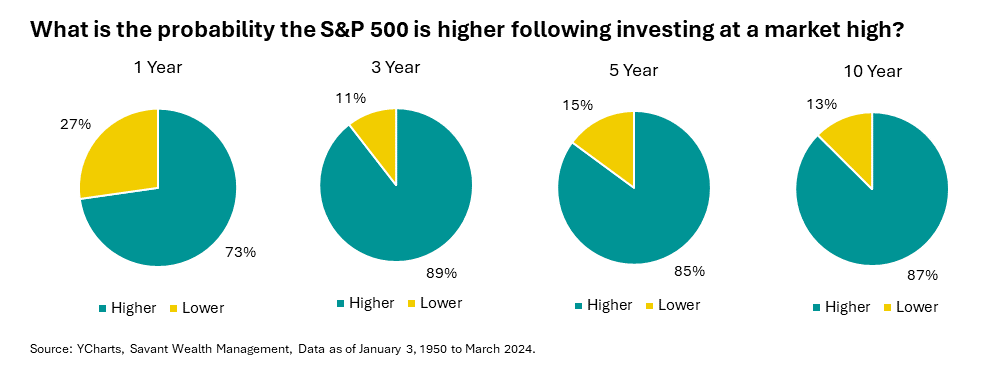
The events of last month reinforce what we already know: markets rise over time because human progress compounds. Innovation, productivity, and economic growth drive long‑term returns; it’s not forecasts, headlines, or geopolitical noise that truly determine market fundamentals. Volatility is a normal part of the journey. New highs are common, not a warning sign. Long‑term planning matters far more than short‑term reactions. And your financial plan is designed to weather exactly the kind of turbulence we saw last month.
Upcoming Events:
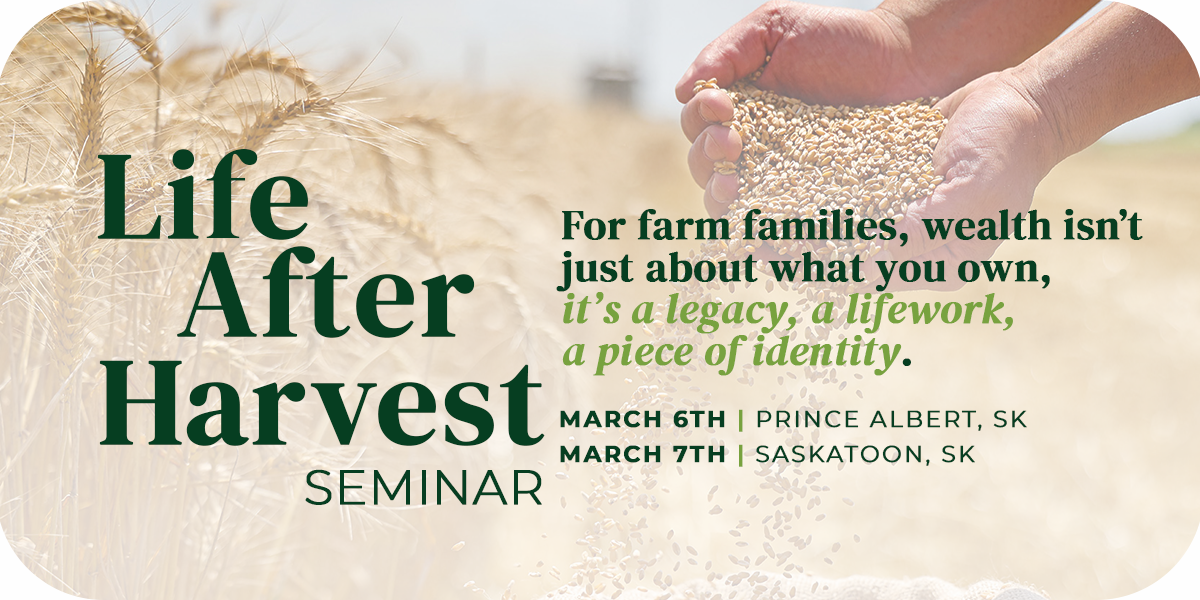
Life After Harvest: Farmland Prices & Your Wealth Plan (Presented by PWM Private Wealth Counsel)
If you’re considering a sale, leasing, or a transition to the next generation for your farmland, this conversation is designed to bring perspective and practical insight. We will discuss how financial planning, investment considerations, estate structures, and today’s farmland values intersect, and what that means for your family over the long term.
Join us for this FREE Seminar and hear from a team of professionals dedicated to the farming industry. You will learn:
- How to understand farmland values, trends, and risks.
- What to consider before selling, leasing, or transitioning your farmland.
- Why a clear financial plan matters for securing farm legacy and living a fulfilling life.
- How to invest your wealth and take a "personal pension" approach with your hard-earned dollars.
Event Details:
- Friday March 6th (4:00 – 6:00 pm) – Prince Albert, SK
- Saturday March 7th (9:00 am – 12:00 pm) – Saskatoon, SK
Register below for your preferred location:
Alternatively, you can also register using the options below.
Limited Seats Available!
📞 By Phone: 306-975-9500
📧 By Email: info@pwmprivate.com
We look forward to seeing you there!