
Managing Family Dynamics
Family dynamics affect interactions and patterns of behavior amongst family members. How family members interact with one another influences communication, leadership, change management and strategy of a family enterprise. Strong family dynamics can be a superpower, leading to an engaged culture, the ability to make quick, impactful decisions, committed employees, and longer-term vision. On the flip side, when ignored or not addressed, poor family dynamics can be responsible for the downfall of a family business or farm
The Three Circle Model
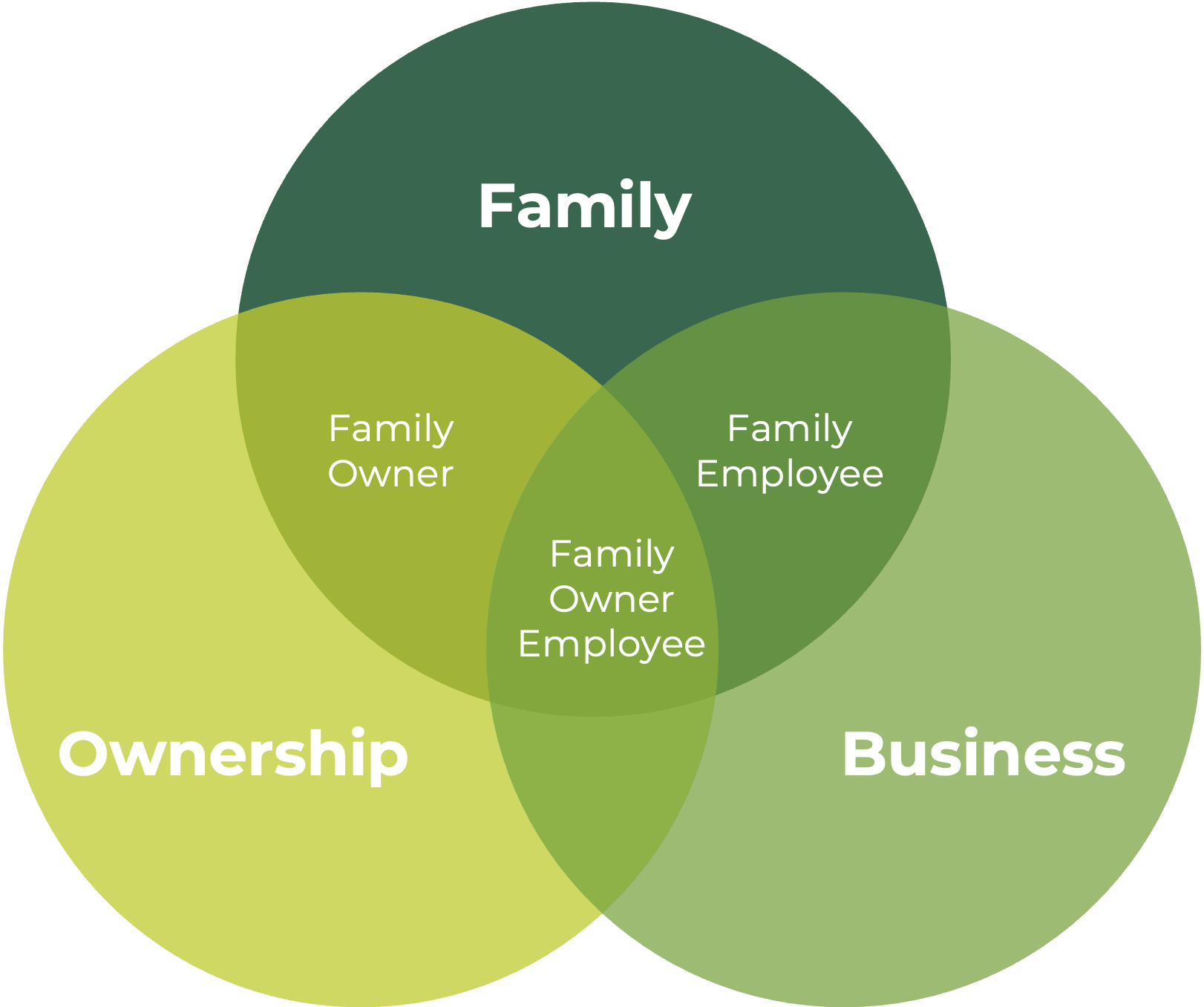
The Three Circle Model2 identifies the three interdependent components of a family enterprise system, namely: Family; Business; and Ownership:
|
When a decision – large or small – arises in a family enterprise, the Three Circle Model helps to highlight:
|
Here’s how the Three Circle Model can help to identify potential family dynamic considerations, and some of the typical decisions members of a family enterprise may face.
Family
- Who: Individuals who are not owners, nor employees, in the family enterprise such as minor aged children or spouses that have married into the family.
- Considerations: Perceived roles, parent/child and sibling relationships, triangulation and informal communication.
- Decisions: Who is at the cottage this weekend? Oversight of the family’s charitable giving.
Family employee
- Who: Grandchildren, children, siblings, or spouses employed in the family enterprise based on their skills and professional experience, or those in training opportunities such as summer employment.
- Considerations: How to support their gaining relevant experience and the succession of the enterprise, leadership opportunities, fair compensation, work/life balance, and intergenerational dynamics.
- Decisions: What are the metrics for promotions and advancement? How to give feedback?
Family owner
- Who: Shareholders who are not employed in the family enterprise. These may be spouses or siblings with neither the time nor the inclination to be actively employed in day-to-day operations.
- Considerations: The nature of reporting and stewardship of the day-to-day operations of the business enterprises, shareholder agreements, and the nature of ownership – active, passive or investor.
- Decisions: Estate planning, or growth versus harvest mindset.
Family owner employee
- Individuals who are both employees and shareholders in the family enterprise including founders, parents, siblings and children who are actively engaged in the day-to-day business.
- Considerations: Operating versus long-term strategy decisions, acquisition and divesture decisions, risk versus reward allocation, nature of ownership managing or operating.
- Decisions: Implementing a mandatory retirement age, promotion or identification of next generation leadership, updating the family enterprise succession plan.
Harness the Power of Family
Collectively, the family enterprise system can be worth far more than the sum of the individual – Family, Ownership and Business – components. This is particularly the case when leadership makes the effort to nurture, and govern, a strong, well-maintained family dynamic.
[1] Attributed to Andrew Carnegie.
[2] Source: Tagiuri, R., & Davis, J.A. (1996), (1982).Bivalent attributes of the family firm. Family Business Review, 9,199-208.
Connect with PWM Private Wealth Counsel
A family business, farm or an investment portfolio does not guarantee a great family, but a family can create a great family enterprise. If you are interested in learning more about family enterprises and implementing governance, please reach out to your PWM Private Wealth Counsel Wealth Advisor or your Q Wealth Portfolio Manager.
Disclaimer
Your PWM Private Wealth Counsel Wealth Advisor or your Q Wealth Portfolio Manager is an owner and partner in the Q Wealth Partnership. Portfolio Management services are provided by Q Wealth. Financial planning services are provided by PWM Private Wealth Counsel. This document has been provided for information purposes only and is not intended to be relied upon as investment, financial, tax or legal advice. Please consult an independent legal or tax professional if considering the implementation of a planning strategy. The planning strategies and technical content are provided for the general guidance and benefit of our clients at the time of writing; however, we cannot guarantee the accuracy or completeness of the information contained herein.