
PWM Perspectives provides valuable insights into market dynamics, investment opportunities through Q Wealth, and key financial indicators. We are committed to keeping you informed with timely updates from PWM Private Wealth Counsel and our partner, Q Wealth Partners, a registered Portfolio Manager providing Portfolio Management Services.
This past week, I was watching my kids in the backyard, bubble wands in hand, running through the summer sun. If you've done this, you know the physics already. There will be some bubbles that catch the breeze and swell into great shimmering globes that float over the fence, while others barely make it off the wand before quietly popping. The kids chase them all with equal enthusiasm. And as tends to happen when you write a monthly article on financial topics, my mind wandered from the backyard to the markets, where, it seems, everyone is talking about bubbles.
Specifically, it seems like every headline has something to say about the artificial intelligence bubble. With AI-related capital spending powering much of this bull market, and a handful of mega-cap technology names dominating the indices, “are we in a bubble?” has become the question of the season. So, this month, we thought we'd wade into the suds (for those keeping tally, we are keeping the puns track record going for another month).
As we like to do with PWM Perspectives (well, at least occasionally), we thought we’d start with a contrarian thought. Bubbles aren't necessarily bad. That may sound odd coming from your portfolio managers and wealth advisors, but let’s look at some details around this.
In his book “Pop! Why Bubbles Are Great for the Economy”, journalist Daniel Gross argues that speculative manias, for all the wreckage they leave behind, have repeatedly built the infrastructure of the next economy. The railroad bubble of the 1800s bankrupted most of the railroads but left behind the tracks. The dot-com bubble vaporized trillions in market value but left behind the fibre-optic cable that today carries your Netflix stream.
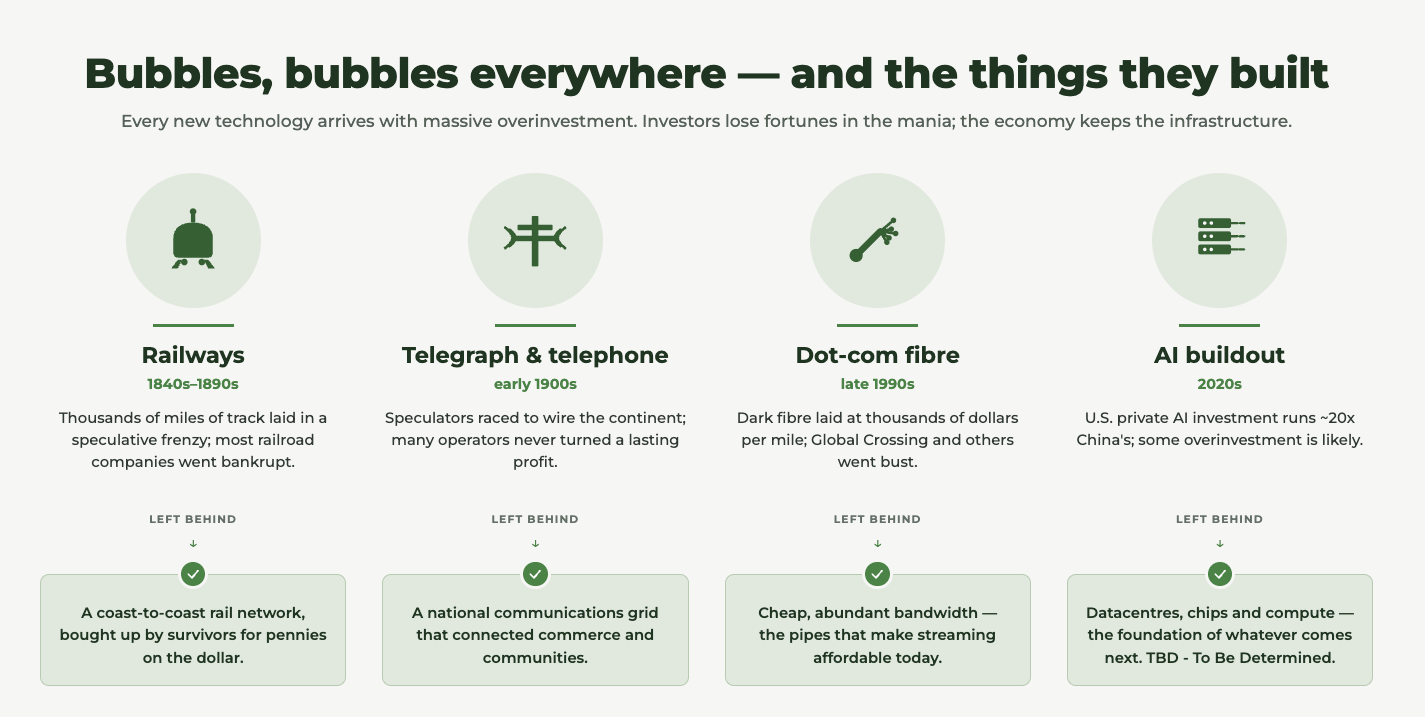
Sources: Dan Gross, Pop! Why Bubbles Are Great forthe Economy; Barry Ritholtz, "Overvalued, Bubble, or Revolution?",The Big Picture (July 17, 2026); Howard Marks, "On Bubble Watch,"Oaktree Capital (January 2, 2025). Historical figures illustrative and rounded;for informational purposes only and not investment advice.
Barry Ritholtz (who we’ve mentioned in this blog before and highly recommend for his great insights), in his recent piece Overvalued, Bubble, or Revolution?, picks up this exact thread. His view is that every new technology arrives with massive overinvestment, and that “misallocation of capital is ultimately a positive”. Well, for the economy and broader society, that is, if not for the specific capital being misallocated.
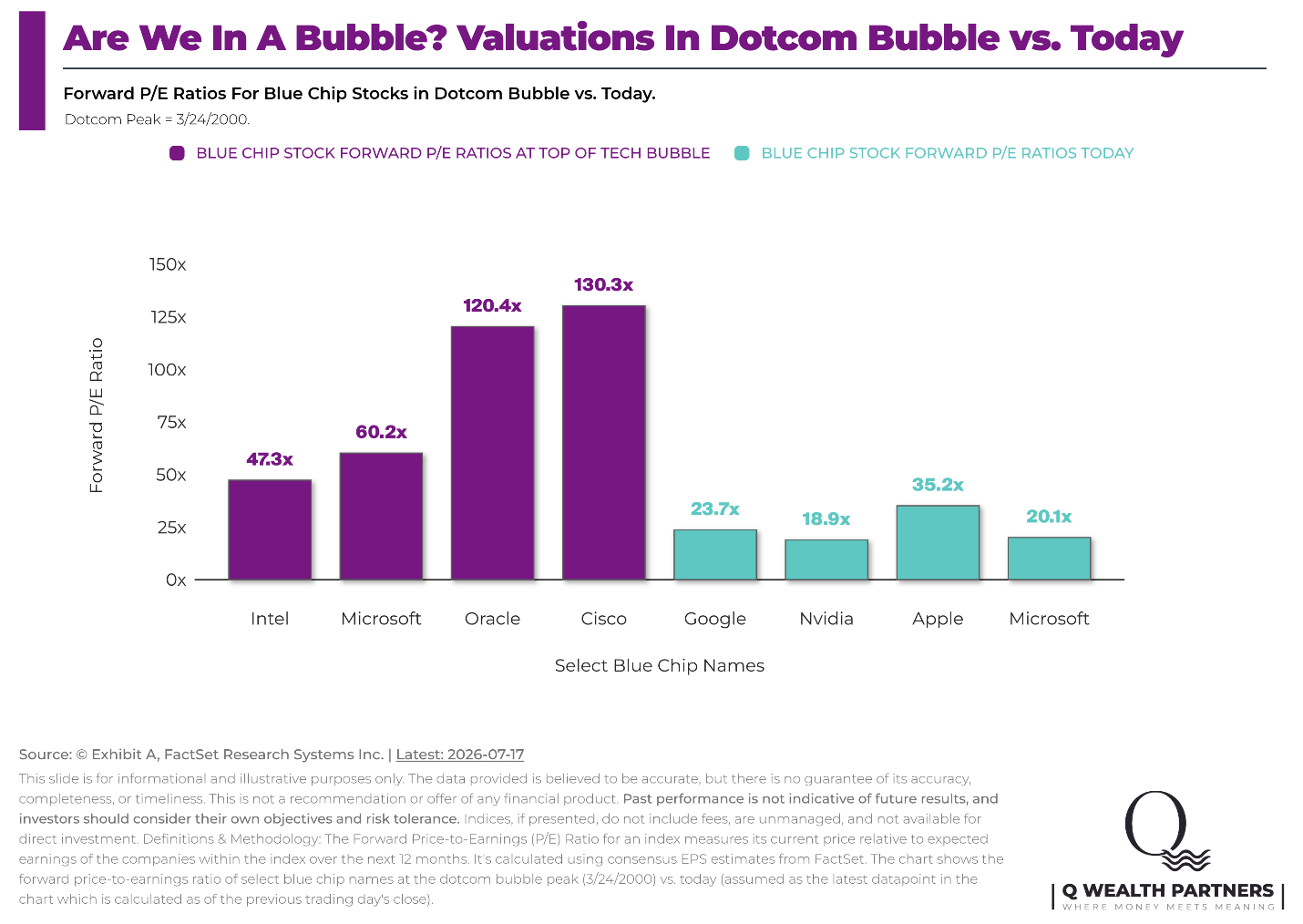
More importantly, Ritholtz marshals some data suggesting today's market, while expensive, doesn't look like 1999. Heading into the dot-com bust, the biggest names traded at eye-watering multiples (see chart below). And on market concentration, he points out that while the top five U.S. stocks now make up about 27% of the S&P 500 (which is down from last year when they were approaching 40%), the top ten companies in Canada, France, Germany, and the UK represent 60-80% of their home indices. If concentration is a problem, it's a much bigger one everywhere else (a humbling stat for us Canadians).
Then there's Howard Marks, whose January 2025 memo “On Bubble Watch” is required reading on this topic, which was written 25 years to the day after his famous “bubble.com” memo correctly called the dot-com top. Marks' central insight is that a bubble is “more a state of mind than a quantitative calculation.”
By that psychological yardstick, Marks observed cautionary signs. There are elevated valuations (which, since his memo was originally published, have been coming down), heavy concentration, and AI enthusiasm, but also counterarguments, including that market leaders are genuinely extraordinary businesses, and he wasn't hearing the “no price too high” talk that marks a true mania.
There’s something that always sits in the back of our minds as we read all these articles and headlines. It’s an old market/industry adage that when everyone is talking about a bubble, that itself might be the sign of one. And here we are, adding our voice to the chorus already being heard at barbecues, business channels, and your local Tim Hortons coffee meet-up.
But the flip side is equally true. It could be said that genuine manias are usually marked by nobody wanting to hear the word “bubble” at all. In 1999, the skeptics were mocked. Today, the skeptics have podcasts, bestselling books, and top billing on many financial sites. A market this openly worried about a bubble is, historically, not behaving like one.
All this brings me back to the backyard. If Gross is right that bubbles are simply part of how economies work, then maybe the right posture isn't to predict the pop, but to look at the bubble wand and accept what my kids already understand; some bubbles get big, some barely leave the wand, but each one creates something. We got railway tracks, telephone lines, and fibre optic cables during past bubbles. And perhaps, this time, the computing infrastructure of the AI era, and maybe, whatever ultimately gets built on top of it.
For your portfolios managed through Q Wealth, the lesson is the same one we've been repeating all year. We don't need to guess which bubbles will soar and which will pop, and frankly, we won't try. Q Wealth-managed portfolios own a broadly diversified mix of assets, so we participate when the big bubbles float while reducing the impact when they burst.
And we stay in the game, because whether the current excitement proves to be overvalued, a bubble, or a revolution, or a bit of all three, the wand keeps dipping back into the soap. Enjoy the rest of the summer sun. The kids have the right idea.